What Is Third-Party Payroll? Meaning, Process and Compliance in India
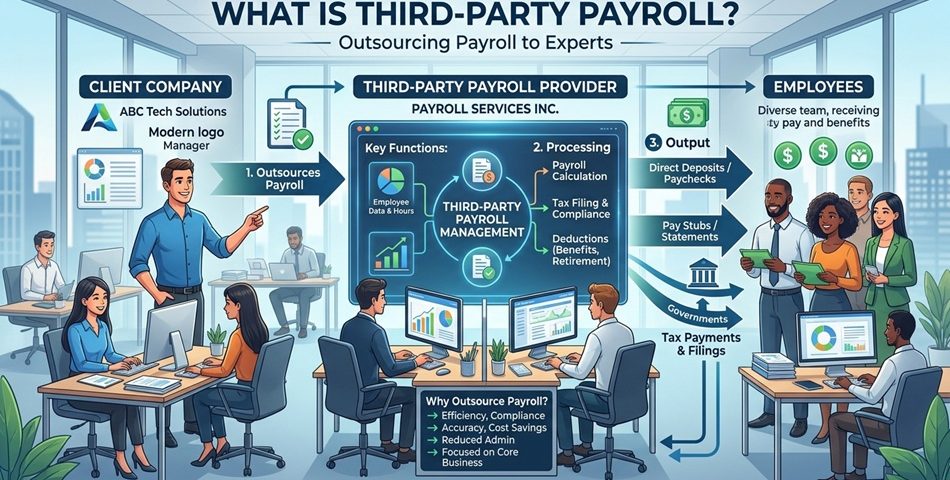
Third-party payroll means outsourcing salary processing, statutory deductions (PF, ESI, TDS, PT), and compliance filings to an external provider instead of handling them with an in-house team. The provider, not the client company, is usually the legal employer of record for the workers on its rolls, while the client directs the day-to-day work. It’s used by businesses that want to avoid the cost and compliance burden of running payroll internally.
What Does “Third-Party Payroll” Actually Mean?
Third-party payroll is an arrangement where a company hands off payroll processing, and often the employment relationship itself, to an external agency. Two related but distinct things get called “third-party payroll” in India, and mixing them up is where most confusion starts:
- Payroll processing outsourcing: The client remains the legal employer, but an outside provider calculates salaries, deducts taxes, and files compliance returns on the client’s behalf. The provider is a vendor, not the employer.
- Third-party payroll staffing: The agency itself becomes the legal employer of record. It signs the employment contract, pays the salary, deducts PF/ESI/TDS, and issues Form 16, while the worker actually reports to and works for the client company. This is the version most commonly seen in IT services, retail, logistics, and other industries that use contract staffing at scale.
Both are widely used across Indian businesses of every size, from startups avoiding the cost of an in-house payroll hire to large enterprises using contract staffing for project-based or seasonal roles.
How Third-Party Payroll Works
- Engagement. The client company signs a service agreement with a payroll or staffing provider, defining scope: payroll processing only, or full employment (staffing model).
- Data handoff. The client shares attendance, leave, salary structure, and new-hire/exit details each cycle.
- Calculation. The provider computes gross pay, overtime, and bonuses, along with deductions: PF, ESI, professional tax, and TDS.
- Compliance filing. The provider files monthly PF/ESI returns, remits TDS, and issues Form 16 at year-end.
- Disbursement. Salaries are paid directly to employees, either by the provider (staffing model) or by the client using the provider’s calculations (processing-only model).
- Ongoing support. The provider handles employee payroll queries, labour-inspector audits, and statutory updates as Indian tax and labour rules change.
Third-Party Payroll vs. In-House Payroll vs. Payroll Software
This is the comparison most guides skip, and it’s the one that actually matters when deciding what to do.
| Third-Party Payroll | In-House Team | Payroll Software | |
|---|---|---|---|
| Who does the work | External provider (or agency, in the staffing model) | Your own HR/finance staff | Your own staff, using automated tools |
| Compliance ownership | Provider handles filings; client retains registration obligations under labour law | Fully on the client | Client retains full responsibility; software reduces manual error |
| Control over process | Lowest: provider sets the pace | Highest | High: you control timing, but automation handles calculations |
| Best for | Businesses wanting to fully offload payroll and compliance, or using contract staffing at scale | Companies with complex, highly customised pay structures and dedicated payroll staff | Businesses that want control and cost savings without outsourcing the function entirely |
| Approximate cost | ₹150-₹500 per employee/month (industry estimate, varies by scope) | Salary + infrastructure cost of a payroll team | Subscription fee, typically lower per-employee cost at scale |
For many growing Indian businesses, payroll software sits in the middle: it removes the manual compliance burden that makes outsourcing attractive, without handing the employment relationship or day-to-day control to a third party.
What a Third-Party Payroll Provider Actually Handles
- Salary and wage calculation, including overtime, bonuses, and reimbursements
- Statutory deductions: Provident Fund (PF), Employee State Insurance (ESI), Professional Tax (PT), and TDS
- Monthly compliance filings and annual Form 16 issuance
- Payslip generation and distribution
- New-hire onboarding paperwork and exit/full-and-final settlement processing, including gratuity calculation for staffed workers who cross the eligibility threshold (typically 5 years of continuous service under the Payment of Gratuity Act, 1972)
- Responding to labour-department or ESI inspector queries on the client’s behalf
- In the staffing model: recruitment, contract issuance, and termination formalities for the workers on its rolls
The Legal Framework: What Employers Need to Know
Third-party payroll staffing in India intersects with the Contract Labour (Regulation and Abolition) Act, 1970, and this is where many businesses underestimate their own compliance exposure.
- The Act applies to establishments engaging a threshold number of contract workers (20 or more, in most states, though some states have raised this threshold under recent labour reforms).
- Where it applies, both sides carry a compliance obligation: the agency (contractor) must hold a valid licence, and the client company (principal employer) must register the establishment with the appropriate labour authority.
- Failure on either side can result in penalties. In some circumstances, regulators or courts can direct that contract workers be absorbed as direct employees.
- A key risk area is the “sham contract” problem: if the client company directly controls the worker’s hours, assigns daily tasks, and supervises performance while the agency does nothing but process payroll, courts may treat the arrangement as direct employment in substance, regardless of the paperwork. Businesses using third-party payroll for what functions like a permanent role should get this structure reviewed by a labour-law professional rather than assuming the arrangement is automatically compliant.
This section is general information, not legal advice. Compliance obligations vary by state and by how the arrangement is actually run in practice.
What Third-Party Payroll Costs in India
Pricing typically runs on a per-payslip model, with industry estimates in the range of ₹150-₹500 per employee per month, depending on the scope of services (basic processing vs. full compliance management vs. staffing). For a 200-person workforce, that translates to roughly ₹3.6 lakh-₹12 lakh a year, a figure that often comes in below the fully-loaded cost of hiring even one experienced in-house payroll professional, before accounting for software and infrastructure costs.
Advantages of Third-Party Payroll
- Lower cost than an in-house payroll department, especially for small and mid-sized businesses
- Reduced compliance risk: providers track changing PF, ESI, PT, and TDS rules so the client doesn’t have to
- Time saved for HR teams, who can focus on hiring, engagement, and performance rather than monthly payroll cycles
- Scalability: easy to add or reduce headcount for project-based or seasonal work without changing internal structure
- Expertise on tap: providers specialise in payroll and compliance full-time, reducing the risk of costly manual errors
Risks and Disadvantages
- Loss of control: the client can’t always determine who works for them, and has limited say if a provider’s good staff leave
- Weaker employee attachment: workers on a third-party payroll may not feel like part of the client company, which can affect retention and engagement
- Compliance exposure remains: outsourcing payroll doesn’t outsource legal responsibility; the client still carries registration obligations under the Contract Labour Act where it applies
- Data security dependency: the client is trusting an external provider with sensitive salary and personal data, so the provider’s security practices matter
- Sham contract risk: treating a third-party payroll arrangement as a way to avoid direct-employment obligations, without actually limiting client control over the worker, is a genuine legal exposure, not just a technicality
Is a Third-Party Payroll Job Safe? (For Employees)
If you’ve been offered a role on “third-party payroll,” it’s a structured, legal, and widely used employment model in India, not inherently risky. That said, it does come with real trade-offs worth knowing before you accept:
- Your legal employer is the agency, not the company you work at day-to-day. Salary, PF, and compliance come from the agency; task direction comes from the client.
- Job security can be lower: the client company can typically end the engagement without the same process as terminating a direct employee.
- Benefits are often narrower: third-party roles frequently exclude perks like housing loans, company vehicles, or the full benefits package direct employees get.
- It’s common at scale, particularly in IT services, and isn’t a signal of a “lesser” job by itself; many long, successful careers run through contract-staffing arrangements. It’s worth asking the agency and client company directly about conversion-to-direct-employment possibilities if that matters to you.
When to Choose Third-Party Payroll vs. Software vs. Hybrid
- Choose third-party payroll (staffing or processing) if you need to scale headcount quickly, want to fully offload compliance risk, or are hiring for project-based/seasonal work.
- Choose payroll software if you want to keep the employment relationship and day-to-day control in-house, but remove manual calculation errors and reduce the compliance burden. See our comparison of the best payroll software in India for options built for Indian statutory requirements.
- Choose a hybrid approach (in-house HR with outsourced compliance filing only) if you have the staff to manage payroll but not the specialised knowledge to keep up with changing PF/ESI/TDS rules.
If you’ve decided outsourcing is the right fit, see our guide to the top payroll outsourcing companies in India for a comparison of leading providers.
Frequently Asked Questions
What is the difference between company payroll and third-party payroll?
In company (direct) payroll, the business is the legal employer and manages salary, deductions, and compliance itself. In third-party payroll, an external provider takes on some or all of that role, and in the staffing model, becomes the legal employer of record.
Is third-party payroll legal in India?
Yes. It’s a widely used, legal employment and business model, but it’s regulated, particularly under the Contract Labour (Regulation and Abolition) Act, 1970, where the worker-count threshold applies. Both the client and the provider carry compliance obligations.
What does a third-party payroll provider actually do?
They calculate salaries and statutory deductions (PF, ESI, PT, TDS), file monthly and annual compliance returns, issue payslips and Form 16, and often manage onboarding/exit paperwork, including gratuity, for the workers on their rolls.
How much does third-party payroll cost in India?
Industry pricing typically runs ₹150 to ₹500 per employee per month, depending on the scope of services, though this varies by provider and the complexity of the client’s payroll.
Is a third-party payroll job less valuable than a direct job?
Not inherently. It’s a structured, legal model used widely across Indian industries, especially IT services. It does come with narrower benefits and potentially lower job security than direct employment, which is worth weighing.
Can a company be penalised for non-compliance in a third-party payroll arrangement?
Yes. Under the Contract Labour Act, both the agency (contractor) and the client (principal employer) can face penalties for failing to register or license the arrangement correctly, where the Act applies.
What’s the difference between third-party payroll and an EOR (Employer of Record)?
They’re closely related: an EOR is essentially a formalised, often cross-border version of third-party payroll staffing, where the EOR is the legal employer while the client directs the work. EOR is more commonly used for hiring across state or country borders.
Should a small business use third-party payroll or payroll software?
It depends on priorities. Third-party payroll fully offloads the work and compliance risk at a per-employee cost; payroll software keeps control in-house while automating the manual, error-prone parts of the process, usually at a lower cost per employee at scale.
Does third-party payroll cover PF and ESI?
Yes. Calculating and remitting PF and ESI contributions, along with filing the related returns, is a core part of what third-party payroll providers handle.
What is a “sham contract” in the context of third-party payroll?
It’s when a client company exercises so much direct control over a “third-party” worker’s day-to-day work, setting hours, assigning tasks, supervising performance, that courts may treat the arrangement as direct employment regardless of the paperwork, exposing the client to compliance risk.

- Best Staffing and Recruitment Agencies in India - September 15, 2026
- Right to Disconnect in India: Where the Law Actually Stands - September 15, 2026
- AI in HR and Recruitment: What’s Actually Real in 2026 - September 15, 2026


