HR Software for Manufacturing Companies in India
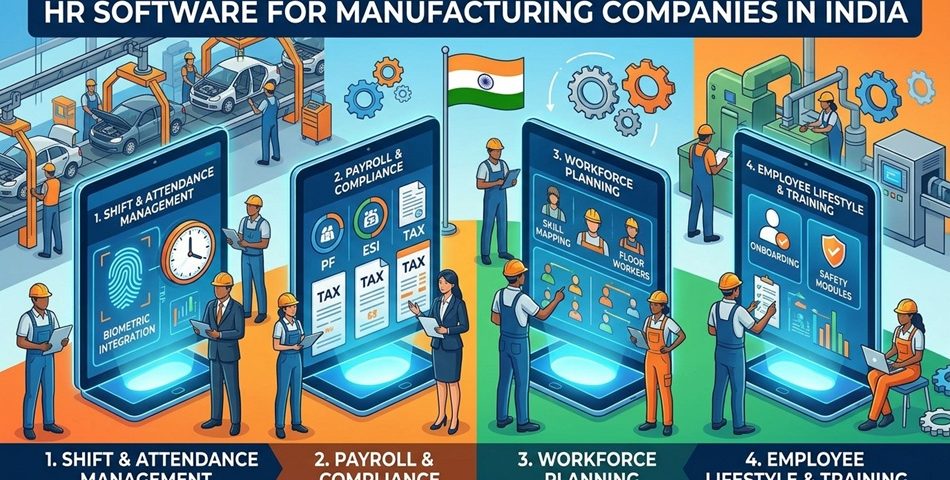
Manufacturing HR looks different from office HR in ways that generic HRMS marketing tends to gloss over: shop-floor biometric attendance across rotating shifts, a statutory overtime cap that actually gets enforced, contract labour tracked separately by law from your direct payroll, and often several plants running semi-independently. This guide covers what to actually check for, and which vendors have real, verifiable manufacturing customers rather than a features page that mentions the word “manufacturing” once.
What manufacturing HR genuinely needs that a generic HRMS might not
OSH Code working-hour compliance, built in, not bolted on
Adult workers are capped at 48 hours a week and 8 hours a day under the Occupational Safety, Health and Working Conditions Code, 2020, which absorbed the Factories Act, 1948 when it came into force on 21 November 2025 and lowered the old 9-hour daily cap by an hour. The Code keeps the Factories Act’s mandatory half-hour rest after 5 continuous hours, caps the total spread-over including rest breaks at 12 hours, and pays overtime at twice the ordinary wage rate for hours beyond the daily or weekly limit. Quarterly overtime is capped at 144 hours for establishments under central jurisdiction per the Central Rules notified 8 May 2026, though establishments in the state sphere follow their own state’s limit until that state notifies its own OSH rules, and those limits currently vary widely, from around 50 hours a quarter in some states to 125 in others. A payroll system that doesn’t enforce these limits at the shift-roster level, catching a violation before it happens rather than flagging it after the payroll run, is doing less than a manufacturing employer actually needs.
Contract labour tracked as its own compliance category
Under the Contract Labour (Regulation and Abolition) Act, 1970, a principal employer using 20 or more contract workmen on any day in the preceding 12 months needs a Registration Certificate, and any contractor supplying 20 or more workmen needs their own Licence, renewed annually. Several states set different thresholds, from as low as 5 to as high as 50, so a multi-state manufacturer genuinely needs software that tracks CLRA status by state and by contractor, not a single company-wide compliance flag.
Multi-plant and shop-floor realities
Biometric attendance across shift patterns, multiple plants each potentially running different shift schedules, and a workforce that’s often a mix of permanent staff, fixed-term employees and contract labour on the same shop floor, all at once. Generic office-first HRMS platforms handle the first of these reasonably well and struggle more with the second two.
Vendors with real, verified manufacturing customers
Vendor marketing claims about “serving manufacturing” are cheap to make and expensive to verify. These three, from the vendor pool already reviewed on this site, have real, checkable manufacturing case studies:
HROne
HROne’s own published case study covers Lux Industries, an apparel and textile manufacturer, reporting 95% automation of leave and overtime calculation and roughly half its blue-collar workforce onboarded through the mobile app, alongside a meaningful drop in HR administrative load. HROne also references manufacturing-adjacent clients including Shyam Metalics and Premier Energies. See our Keka vs HROne comparison for how it stacks up more broadly.
Pocket HRMS
Pocket HRMS names Goel Steel Company, a steel manufacturer operating since 1973 across multiple locations, and Subham Tanks and Liners, with a named managing director testimonial, as manufacturing customers, both verified directly on Pocket HRMS’s own case-study pages, covering biometric attendance, payroll automation, statutory compliance and employee self-service.
Keka
Keka’s own customer-story pages verify three manufacturing clients: Hartex Rubber (tyre and tube manufacturing), Sanvira Industries, and notably Varmora Granito, a genuine multi-plant deployment across 11 regional plants and over 1,150 employees, the strongest single multi-location proof point found across the vendor pool for this vertical.
Beyond these three, no dedicated manufacturing case study or feature page was found for the other vendors in this site’s verified pool (Zoho People, Darwinbox, greytHR, Zimyo, Kredily, Qandle, sumHR, PeopleStrong, SAP SuccessFactors). That doesn’t rule them out for a manufacturing deployment, since general-purpose HRMS platforms can often be configured for shift and compliance needs, but it does mean the burden of proof on manufacturing-specific fit sits with the buyer to verify directly, rather than something to assume from a features page.
A buyer’s checklist for manufacturing HR software
- Does the shift/roster module enforce Factories Act hour and spread-over limits automatically, or only report on violations after the fact?
- Can it track CLRA registration/licence status per contractor and per state, not just as a single company-wide field?
- Does biometric attendance integrate directly with payroll, including overtime calculated at the correct statutory multiplier?
- Can it run as one system across multiple plants with different shift patterns, or does each plant end up as a semi-separate instance?
- Ask directly for a manufacturing reference customer, ideally one with a similar plant count and blue-collar-to-staff ratio to your own, rather than accepting a features list alone
Frequently asked questions
Do I need manufacturing-specific software, or will general HRMS work?
A general-purpose HRMS can often be configured to handle shift rules and contract-labour tracking, but the configuration burden and risk of missing a Factories Act edge case is meaningfully higher than with a vendor that already has manufacturing customers to draw configuration patterns from.
What’s the real difference between contract labour and fixed-term employment for compliance purposes?
Contract labour falls under the CLRA Act and involves a third-party contractor as the direct employer. Fixed-term employment is a direct employment relationship with the manufacturer itself, just for a defined period, and carries different obligations, including gratuity eligibility after one year under the current labour codes. See our note on this distinction in temporary and contract employees.
Does the Factories Act apply to every manufacturing unit?
It applies to factories meeting defined worker-count and power-usage thresholds under the Act, which covers the large majority of organised manufacturing units in India, but a very small unit may fall outside its scope depending on those specific thresholds.
How many contract workers trigger CLRA registration?
20 or more on any day in the preceding 12 months for the principal employer nationally, though several states set their own, sometimes lower, thresholds, so check your specific state’s rule rather than assuming the central figure applies everywhere.
Is multi-plant deployment meaningfully harder than multi-location office HR?
Generally yes, because shift patterns, statutory registers and contract labour compliance can genuinely differ plant to plant in a way that office locations running the same working hours usually don’t.
For the broader payroll and attendance category this sits inside, see our payroll software and time and attendance software guides, and the full vendor directory.

- Best Staffing and Recruitment Agencies in India - September 15, 2026
- Right to Disconnect in India: Where the Law Actually Stands - September 15, 2026
- AI in HR and Recruitment: What’s Actually Real in 2026 - September 15, 2026