Full and Final Settlement: The Step-by-Step Process for HR Teams
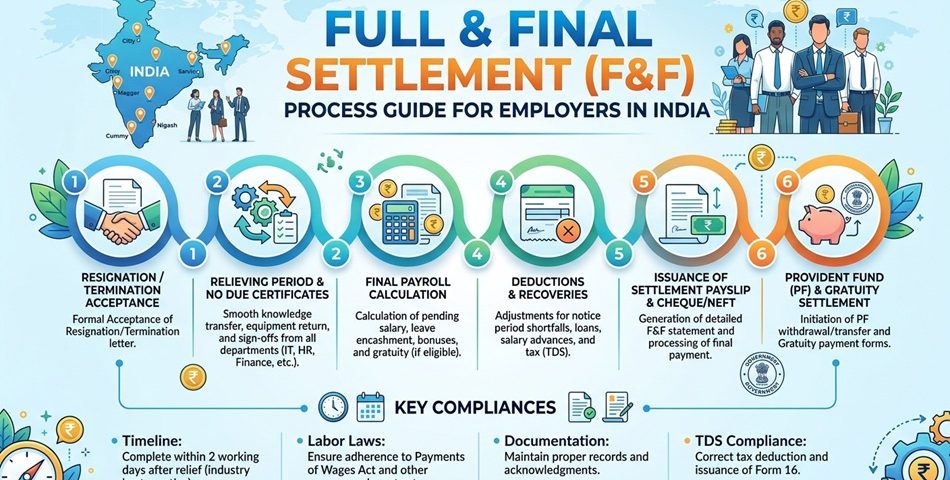
Knowing what full and final settlement means is one thing. Actually running the process without the finance team, IT, the exiting employee’s manager and payroll all working off different timelines is a different problem entirely, and it’s gotten sharper since the two-day wage rule came into force. This is the execution guide: who owns what, in what order, and where most FnF processes actually break.
The rule that changed everything: two working days
Section 17(2) of the Code on Wages, 2019, in force since 21 November 2025, requires final wages to be paid within two working days of an employee’s last working day, whether the exit is resignation, termination, retrenchment or closure. There’s no exemption by headcount or designation. The old 30-45 day norm most Indian companies still quote informally is no longer the legal standard.
Worth being precise about enforcement reality here: the legal obligation applies now, but penalty enforcement appears to be phasing in through mid-2026 as states finish notifying their own rules under the Code, following the central rules notified in May 2026. That’s a meaningfully different statement from either “nothing has changed” or “you’ll be fined tomorrow,” and it’s the accurate one. Build toward the two-day standard now rather than waiting for enforcement to force the issue.
What’s actually inside the two-day window, and what isn’t
This is a genuine source of confusion worth clearing up directly: the two-day rule covers wages, meaning pending salary and closely related pay components. It does not compress two other major FnF components onto the same timeline:
- Gratuity keeps its own statutory window under the Payment of Gratuity Act: payable within 30 days of becoming due.
- Any EPF withdrawal the employee initiates separately through EPFO typically takes 15-20 working days to process, and isn’t something the employer controls end to end.
Treat FnF as having one fast track (wages, in two days) and two slower, separately-timed tracks (gratuity and PF) rather than assuming everything compresses to the same deadline.
Run clearances in parallel, not in sequence
The single most common process mistake is treating IT, admin, finance and HR clearance as a relay, each department waiting for the previous one to finish before starting. With a two-day wage deadline, that structure doesn’t work. The clearances need to start the moment resignation is accepted or termination is decided, not on the last working day itself:
| Track | What happens | Owner | When it should start |
|---|---|---|---|
| IT | Access revocation, asset return (laptop, ID card, SIM) | IT/Admin | Notice period start |
| Finance | Loan/advance reconciliation, outstanding reimbursements | Finance | Notice period start |
| Leave | Leave balance audit for encashment | HR/Payroll | Notice period start |
| Notice recovery | Calculate any shortfall if notice isn’t fully served | HR/Payroll | Once actual last working day is confirmed |
| Wage computation | Final salary, pro-rated variable pay, deductions | Payroll | Last working day |
| Payout | Disbursement and settlement statement | Payroll | Within 2 working days of last working day |
What gets paid, and what gets recovered
Payable to the employee: salary for days actually worked in the final month, encashment of unused earned leave, gratuity if five years of continuous service are complete, any pro-rata statutory bonus already earned, and any variable pay already vested under the applicable policy.
Recovered from the employee: notice pay for any shortfall between required and actually served notice, outstanding salary advances or loans, and the value of any company asset not returned. TDS is applied to the taxable portion of the settlement before the net amount is paid out.
Run your own estimate with the Full and Final Settlement Calculator, and the notice-shortfall piece specifically with the Notice Period Buyout Calculator.
Common mistakes that hold up settlements
- A blanket internal policy still quoting 45 days as the settlement timeline, which is now simply unlawful as a standard practice
- Waiting until the last working day to begin asset and access clearance, leaving no room to hit a two-day payout window
- Deducting for unreturned assets without a documented policy or acknowledgment the employee signed at onboarding, which invites disputes
- Leave-encashment miscalculations from applying a national default rather than checking state-specific leave rules where they differ
- A payroll system genuinely not built for a 48-hour turnaround, treating FnF as just another item in the regular monthly cycle instead of an exception process with its own faster path
Frequently asked questions
Does the two-day rule apply to voluntary resignation as well as termination?
Yes. Section 17(2) covers resignation, termination, retrenchment and closure alike, without a different timeline by exit type.
What if the employee hasn’t returned company assets by the last working day?
Employers commonly recover the value of unreturned assets from the settlement itself, provided this is documented policy. Withholding the entire settlement indefinitely over an unreturned asset is on weaker legal footing than a specific, itemised deduction.
Is gratuity part of the same two-day payment?
No. Gratuity runs on its own 30-day statutory window under a different Act. Wages and gratuity should be tracked as separate deadlines, not combined into one.
Can an employer delay settlement if there’s a pending disciplinary matter?
This is a genuinely contested area in practice rather than something the wage-payment rule addresses directly; if a settlement is being held for a documented, specific reason connected to misconduct, that decision is worth involving legal counsel in rather than defaulting to an indefinite hold.
Does a smaller company get more time to comply with the two-day rule?
The rule doesn’t carve out an exemption by company size or headcount in its text.
For the exit-related components feeding into this process, see our notes on notice periods and leave encashment.

- Best Staffing and Recruitment Agencies in India - September 15, 2026
- Right to Disconnect in India: Where the Law Actually Stands - September 15, 2026
- AI in HR and Recruitment: What’s Actually Real in 2026 - September 15, 2026