Gig and Platform Worker Social Security: What Changed Under the New Labour Code
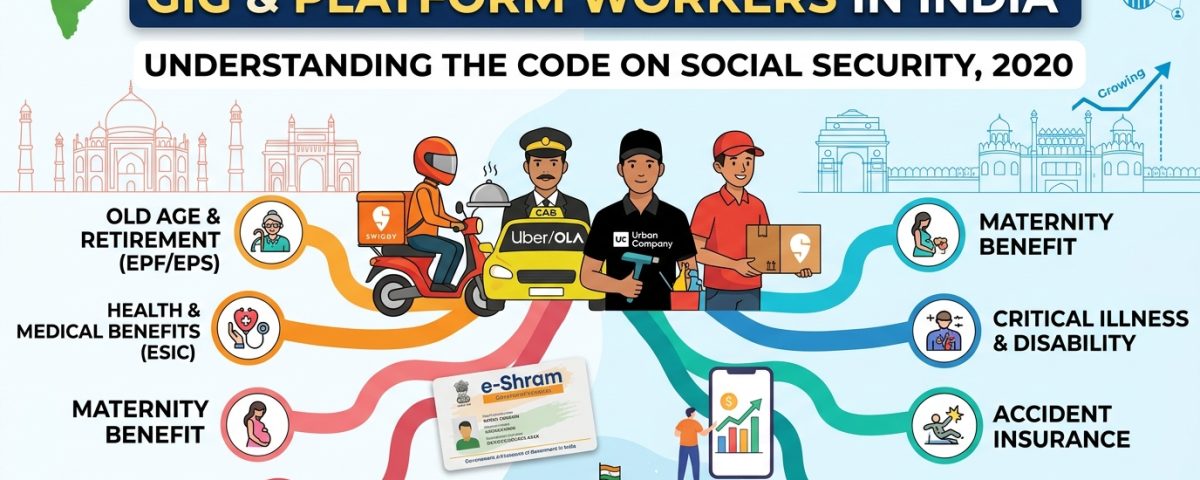
For the first time, Indian law recognises gig and platform workers as a category entitled to social security, separate from both traditional employees and informal, entirely uncovered labour. The framework exists. The exact numbers that make it operational are, as of this writing, still being finalised. This matters differently depending on which side of it you’re on: platforms that count as aggregators under the Code have direct obligations, and any employer that simply uses gig-economy staffing for part of its workforce, without running a platform itself, needs to know what its providers are on the hook for. Here’s what’s actually settled for each, and what’s still moving.
What changed
The Code on Social Security, 2020, in force nationally since 21 November 2025, introduces two new statutory categories: a gig worker (Section 2(35)), someone working outside a traditional employer-employee relationship, and a platform worker (Section 2(55)), specifically someone whose work is accessed or facilitated through a digital platform. An aggregator (Section 2(1)/2(2)) is the digital intermediary connecting buyers and sellers of a service, and the Code’s Seventh Schedule lists nine categories of aggregator this applies to: ride-sharing, food and grocery delivery, logistics, e-marketplaces, professional services, healthcare, travel and hospitality, content and media, and a catch-all “other” category.
How the funding is supposed to work, and what’s still unsettled
Aggregators are required to contribute a percentage of their annual turnover toward gig and platform worker welfare, generally described as 1-2% of turnover, capped at the lower of that figure or 5% of amounts actually paid to gig and platform workers. That’s the framework as written. What isn’t yet settled: the exact contribution rate within that 1-2% band, and the precise commencement date for enforcement. Sources on this genuinely disagree, some describing central rules as notified with a real effective date already passed, others describing the specific rate and start date as still pending. Treat any single confident number you see elsewhere with caution, and check the current status directly before relying on it for a contribution calculation.
Registration: the e-Shram Aggregator module
Aggregators register through a dedicated module on the e-Shram portal, launched in December 2024. Several major platforms, including Zomato, Swiggy, Ola, Uber, Blinkit, Zepto, Urban Company, Amazon, Rapido and Porter, were among the first onboarded. The registration requirements as designed: new workers registered in close to real time as they join the platform, existing workers uploaded within a defined window after rules take effect, and monthly updates thereafter.
What’s actually covered
The framework points toward health coverage modelled on the PM-JAY scheme, accident insurance, life and disability cover, maternity-related benefits, and old-age protection. The precise scheme design, benefit amounts, and delivery mechanism are government-determined and, like the contribution rate, still being finalised in several respects rather than fully fixed at the level of detail an EPF or ESI scheme already has.
A state-law wrinkle worth knowing
Karnataka and Rajasthan have each passed their own state-level gig worker welfare legislation, running in parallel to the central Code rather than replacing it. If you operate in either state, both the central framework and the relevant state law may apply, which is worth flagging to whoever handles your compliance rather than assuming the central Code is the whole picture.
What this means if you’re not a food-delivery or ride-hailing platform
The aggregator categories in the Seventh Schedule are broader than the household-name platforms most people think of first. Any company that classifies as a digital intermediary connecting service providers to customers, including in professional services, logistics, or healthcare booking, falls within scope. Separately, companies that simply engage gig workers through a third-party platform rather than running one themselves should treat this as a reason to review how their gig-economy staffing arrangements are structured and documented, since misclassification risk (treating what’s functionally an employment relationship as a gig arrangement to avoid obligations) is a real and separate exposure from the aggregator-contribution question.
What to do now
- If you’re an aggregator under the Seventh Schedule definitions, register on the e-Shram Aggregator module if you haven’t already, and don’t wait for the exact contribution rate to be finalised before building the reporting capability to calculate it
- If you use gig-economy staffing without being an aggregator yourself, confirm with your workforce provider how they’re handling registration and contribution on their end
- Set a calendar reminder to re-check the contribution rate and effective date in a few months rather than treating today’s answer as final
Frequently asked questions
Does this replace EPF and ESI for gig workers?
No. Gig and platform workers were never covered by EPF or ESI in the way traditional employees are, since those schemes are built around an employer-employee relationship. This is a new, separate coverage track, not an extension of the existing ones.
Is the contribution rate 1% or 2%?
The Code sets a 1-2% band, capped at 5% of amounts paid to gig and platform workers, but the precise rate within that band has not been consistently confirmed as finalised across sources as of this writing. Verify the current figure directly before using it in a cost projection.
What counts as a “platform worker” versus a regular gig worker?
A platform worker’s arrangement specifically involves accessing or being assigned work through a digital platform or app. A gig worker is the broader category, covering arrangements outside a traditional employment relationship whether or not a digital platform is involved.
Do small companies using a handful of gig workers need to register as an aggregator?
Only if the company itself functions as the digital intermediary matching workers to customers, matching one of the Seventh Schedule categories. A company that simply hires individual gig workers directly, without running a platform connecting multiple providers to customers, isn’t an aggregator in the sense the Code uses.
What happens if an aggregator doesn’t register or contribute?
Enforcement mechanics are tied to the same rules still being finalised around rate and commencement, so the specific penalty structure is best confirmed directly rather than assumed at this stage.
For how gig and contract staffing more broadly fits into workforce planning, see our note on temporary and contract employees, and on outsourcing models generally, what HR outsourcing actually covers.

- Best Staffing and Recruitment Agencies in India - September 15, 2026
- Right to Disconnect in India: Where the Law Actually Stands - September 15, 2026
- AI in HR and Recruitment: What’s Actually Real in 2026 - September 15, 2026