HR and Payroll Compliance Calendar for India
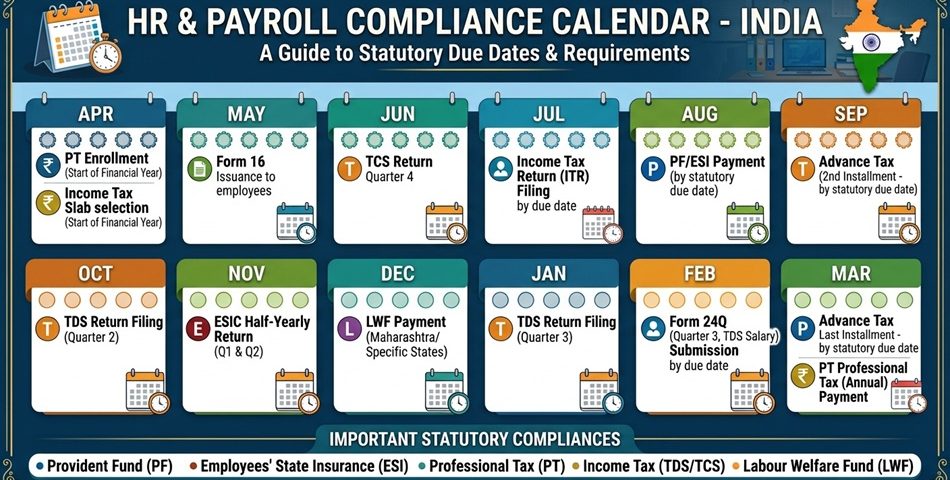
Most compliance-calendar articles give you a table and stop there. The table is necessary but it isn’t the hard part: the hard part is knowing which dates are genuinely fixed nationally and which ones vary by state, because treating a state-specific deadline as if it were universal is exactly how a Professional Tax or Labour Welfare Fund filing gets missed. This calendar separates the two.
Fixed national due dates
| Filing | Frequency | Due date |
|---|---|---|
| PF (EPF) ECR and challan | Monthly | 15th of the following month |
| ESI contribution | Monthly | 15th of the following month |
| ESI half-yearly return | Half-yearly | 12 November (Apr-Sep period), 12 May (Oct-Mar period) |
| TDS on salary deposit | Monthly | 7th of the following month (30 April for March) |
| Form 24Q (quarterly TDS return) | Quarterly | 31 Jul, 31 Oct, 31 Jan, 31 May |
| Form 16 issuance | Annual | 15 June |
These six are consistent across sources and don’t vary by state or company size. If you automate only one part of your compliance calendar, this table is the safest one to lock into a payroll system, since it applies to every employer covered by each scheme regardless of location.
State-specific: don’t trust a single national date
Professional Tax. Deducted and deposited monthly, but the exact due date, the slab structure, and whether PT applies at all is set independently by each state. Several otherwise-detailed compliance calendars quote a single “15th” or “last day of the month” figure as if it were universal, which it isn’t. Check your own state’s PT schedule directly, or use the Professional Tax Calculator, which handles the state-by-state variation rather than assuming one rule fits all.
Labour Welfare Fund. Where a state levies LWF at all, contributions are commonly collected half-yearly, often around June and December, but both the applicability and the exact dates are state-specific. Treat any calendar that gives LWF one national date the same way you’d treat a PT calendar with one national rate: as a simplification, not a filing instruction.
POSH annual report. Most guidance defaults to 31 January, but this isn’t universal either; some districts, Gurugram among them, allow filing through the end of February. Check your specific district’s actual cutoff before treating 31 January as a hard deadline.
Annual and periodic filings worth tracking separately
- Statutory bonus (Payment of Bonus Act). Bonus for a financial year is generally payable within eight months of the year’s close, commonly around 30 November, with the associated annual return (Form D) typically expected around 30 days after that, commonly cited as 31 December. Check the Statutory Bonus Calculator for the underlying eligibility and amount rules.
- Gratuity nomination review. Not a statutory filing with a fixed date, but worth an annual internal check alongside other year-end compliance, since a stale nomination is one of the more common causes of delay when a gratuity claim actually needs to be paid.
Why this needs a system, not a spreadsheet
The pattern across every filing above is the same: the national dates are fixed and few, and the state-specific ones are numerous and easy to get wrong at scale. A single-location employer can track this manually without much risk. A multi-state employer running the PT and LWF tables in a spreadsheet updated once a year is taking on quiet, compounding risk every time a state revises its own schedule without an obvious announcement. This is one of the more concrete reasons multi-state employers move to payroll software with built-in statutory compliance, rather than because of the payroll calculation itself, which is comparatively simple.
Frequently asked questions
What happens if a PF or ESI deposit is late?
Both attract interest and, for PF specifically, damages under the EPF Act calculated on a sliding scale based on how late the deposit is, in addition to the base contribution owed.
Is Professional Tax deducted in every state?
No. Only some states levy it. Check whether your operating state is one of them before assuming a PT deduction line needs to appear on payslips at all.
Does the TDS deadline change if 7 April or 30 April falls on a weekend or holiday?
Government due dates generally shift to the next working day when they fall on a bank holiday, but this is worth confirming against the specific year’s calendar rather than assumed automatically.
Who is responsible for tracking state-specific dates across multiple offices?
In practice, this works best with one named owner per state or region rather than leaving it to whichever local office happens to notice a filing is due, since state schedules change without much fanfare.
Does a compliance calendar replace the need for a payroll audit?
No. A calendar tells you when something is due. It doesn’t verify that what was actually filed was calculated correctly, which is a separate and equally important check.
For the underlying calculations behind each filing, see the PF Calculator, ESI Calculator and TDS on Salary Calculator.

- Best Staffing and Recruitment Agencies in India - September 15, 2026
- Right to Disconnect in India: Where the Law Actually Stands - September 15, 2026
- AI in HR and Recruitment: What’s Actually Real in 2026 - September 15, 2026