The Four Labour Codes: A State-by-State Compliance Tracker for HR Teams
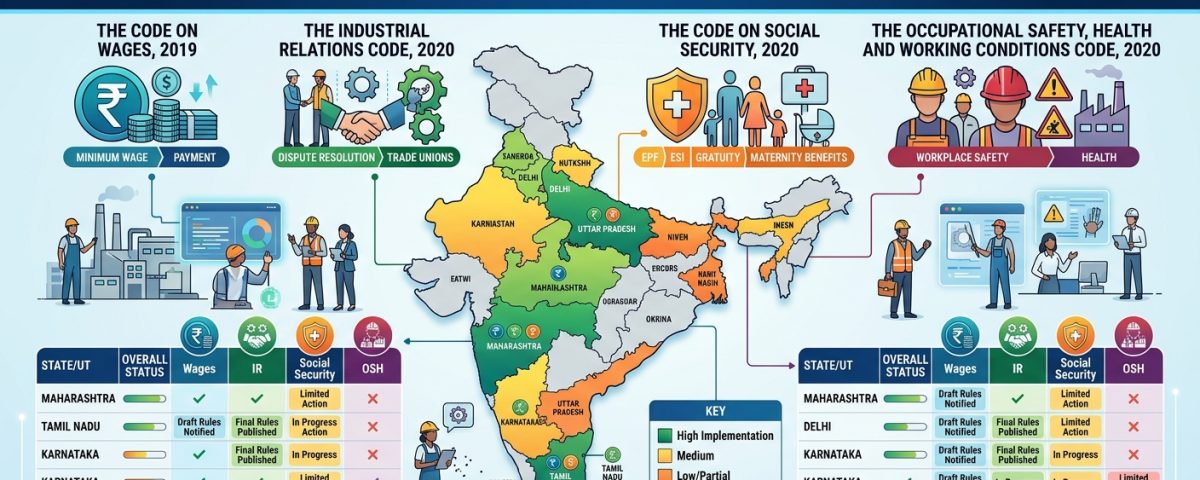
India’s four Labour Codes went into force nationally on 21 November 2025. If you stopped reading there, you’d assume every employer in the country is now operating under one clean, settled rulebook. In practice, “in force” and “actually enforceable in your state” are two different things, and the gap between them is where most of the confusion in HR forums and compliance checklists comes from. Several trackers already published on this topic contradict each other on which states have finished the job, sometimes flatly. This page is deliberately built to avoid adding a fifth wrong table to that pile: it separates what is genuinely settled from what is still moving, and tells you how to verify your own state rather than asking you to trust a number that may already be stale by the time you read it.
What actually happened, and when
| Date | Event |
|---|---|
| 21 November 2025 | All four Labour Codes (Code on Wages 2019, Industrial Relations Code 2020, Code on Social Security 2020, Occupational Safety, Health and Working Conditions Code 2020) brought into force nationally, repealing 29 central labour laws. |
| 30 December 2025 | Central Government re-published draft rules for objections and suggestions, a step some early trackers skipped, which caused them to misdate what counted as “final.” |
| 8-9 May 2026 | Final Central Rules notified for all four Codes (Wages, Industrial Relations and Social Security on 8 May; Occupational Safety on 9 May). |
Those three facts are corroborated across multiple independent sources, including PIB releases and law-firm alerts from Cyril Amarchand Mangaldas, KPMG, EY and DLA Piper, and can be treated as settled.
Why “in force nationally” isn’t the whole story
Labour sits on the Concurrent List of the Constitution, so central legislation only tells half the story. For a Code to be fully operative on the ground in a given state, three separate things have to line up:
- The Code itself is in force nationally (done, since 21 November 2025)
- The Central Government has notified its rules under that Code (done, since May 2026)
- The state government has separately notified its own rules, since states administer and enforce most of the day-to-day provisions
It’s the third step that’s genuinely unsettled and moving state by state, and it’s exactly where the trackers currently online disagree with each other, and in some cases with what law firms who are actually advising clients on this are seeing.
What we can actually verify right now
As of January 2026, Cyril Amarchand Mangaldas, a top-tier Indian law firm, credited only Gujarat and Arunachal Pradesh with having finalized their own state rules across all four Codes. Several other trackers claim additional states, including Bihar, Chhattisgarh and Karnataka, had reached the same point around the same time, but at least one law firm’s own client note from after that date describes Karnataka’s final rules as still awaited. Given the sources genuinely conflict, and given that months have passed since any of this was checked, the responsible thing to do here is not present a longer list as settled fact. If you need your specific state’s status for a compliance decision, verify it directly rather than trusting any single tracker, including this one, without a current source.
How to check your own state
The state notification, once issued, is public. To verify where your state actually stands:
- Search “[your state] labour department labour codes rules notification” and look for the state labour department or labour commissioner’s own site, not a third-party summary
- Check whether your payroll or HRMS vendor has published a state-specific compliance note, since vendors serving large multi-state employers often track this more actively than generic trackers
- If you use outside counsel or a compliance consultant, this is a fair question to put to them directly rather than assume from a blog post, including this one
What’s already affecting payroll regardless of state rollout
Several provisions are anchored to the central Codes and rules, which are now settled, so they apply regardless of where your state’s own notification process stands. If you haven’t already adjusted for these, they’re worth checking first:
- The 50% basic pay rule under the Code on Wages, which requires basic plus dearness allowance to be at least half of total remuneration, reshaping how CTC is structured. See our coverage of this rule and check your own structure with the Salary Breakup Calculator.
- Fixed-term employees becoming entitled to gratuity after just one year of service, rather than the earlier five, under the Industrial Relations Code. See our note on this inside fixed-term versus contract labour.
- An optional 12-hour, 4-day compressed work week within the 48-hour weekly cap, clarified by the Labour Ministry as not mandatory. Covered in our shift-planning guide.
- Final wages on resignation or termination now due within 2 working days of the last working day under Section 17(2) of the Code on Wages, a sharp compression from the informal 30-45 day norm most companies still quote. See our note on this rule.
A practical approach while this settles
Waiting for every state to finish notifying rules before acting isn’t realistic, and it isn’t necessary for the provisions above, which are already binding. A reasonable approach: apply the settled central provisions now, keep a short internal log of when you last checked your own state’s status and against what source, and re-verify quarterly rather than once and forget it. If you operate in multiple states, this is worth assigning to one owner rather than leaving each location to interpret it separately.
Frequently asked questions
Are the four Labour Codes law right now?
Yes, nationally, since 21 November 2025, with central rules finalized in May 2026. Whether every specific provision is actively enforced in your state depends on that state’s own rule notification, which is still uneven.
Do the old laws (Industrial Disputes Act, Factories Act, and so on) still apply?
The four Codes repealed 29 central labour laws that they replace. Where a state hasn’t yet notified its own rules for a Code, the practical transition can be uneven, which is exactly why direct state-level verification matters more than usual right now.
What happens if my state hasn’t notified rules yet?
The central provisions that don’t require state rule-making, like the wage-payment timeline and the wage-definition rule, still apply. Provisions that depend on state-specific implementation detail are the ones genuinely in limbo until your state acts.
Is the 50% basic pay rule enforceable everywhere already?
It flows from the central Code on Wages and its central rules, both settled, so yes, it’s a reasonable working assumption everywhere, not something waiting on a state notification.
How often should I re-check my state’s status?
Quarterly is a reasonable cadence given how much this has moved over the past year, more often if you’re mid-way through a compliance project tied to a specific provision.
For the minimum-wage side of this transition specifically, see our glossary entry on minimum wages and check compliance with the Minimum Wage Compliance Calculator.

- Best Staffing and Recruitment Agencies in India - September 15, 2026
- Right to Disconnect in India: Where the Law Actually Stands - September 15, 2026
- AI in HR and Recruitment: What’s Actually Real in 2026 - September 15, 2026