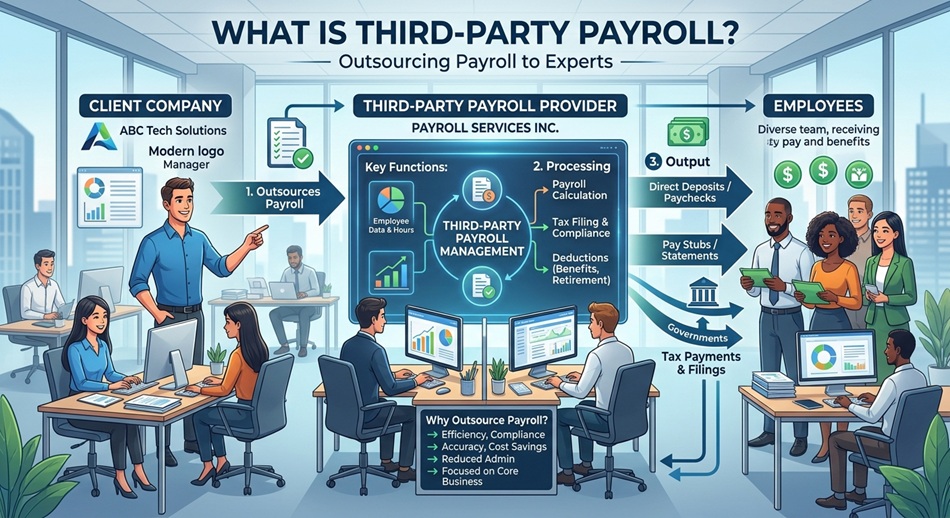
What Is a Payroll Management System?

A payroll management system is the process (and usually the software) that calculates what each employee is owed, applies the correct statutory deductions, pays them accurately and on time, and keeps the records regulators expect to see. In India, that means far more than “pay minus tax”: PF, ESI, professional tax, and TDS all apply differently depending on salary, state, and company size, which is exactly where manual payroll tends to break down.
What a Payroll Management System Actually Does
Payroll processing runs in three stages every cycle. Pre-payroll work gathers and validates the inputs: attendance, leave taken, overtime, new joiners, exits, and any one-off payments like reimbursements or bonuses. Actual processing applies the salary structure and every statutory deduction to calculate net pay. Post-payroll work generates payslips, initiates bank transfers, and produces the compliance reports and filings that PF, ESI, and tax authorities expect.
A good system automates the middle step entirely and makes the first and last steps far less manual. A bad or absent system means someone is recalculating PF and TDS by hand every month, which is both slow and exactly where compliance errors creep in.
The Core Components of Indian Payroll
| Component | Employee Contribution | Employer Contribution | Applies When |
|---|---|---|---|
| EPF (Provident Fund) | 12% of Basic + DA | 12% (split 3.67% EPF + 8.33% EPS) | Mandatory up to ₹25,000/month wage ceiling |
| ESI | 0.75% of gross wages | 3.25% of gross wages | Gross wages up to ₹21,000/month (₹25,000 for employees with disabilities) |
| Professional Tax | State-specific | N/A (deducted from employee) | Varies by state, statutory max ₹2,500/year |
| TDS | Per income tax slab | N/A | Based on employee’s total taxable income and declared regime |
Beyond these deductions, a salary structure typically breaks down into Basic pay, HRA, and special allowances, with the split affecting both take-home pay and how much PF gets deducted, since PF is calculated on Basic + DA, not gross salary. Getting this structure wrong doesn’t just create an unhappy employee; it can create a genuine compliance gap that surfaces at the worst possible time, during an audit or an employee’s exit settlement.
Manual, In-House Software, or Outsourced: Choosing the Right Model
Manual payroll (spreadsheets, essentially) can work below roughly 15-20 employees, but the moment PF or ESI compliance enters the picture, the error risk climbs fast. In-house payroll software automates the calculation and filing logic while keeping the process and the data under your own team’s control, which is the right fit for most companies with someone able to own the monthly cycle.
Fully outsourced payroll hands the actual processing to a provider and makes sense mainly when there’s no internal bandwidth to run it at all, not simply to avoid buying software. We’ve covered this decision in more depth, including real India pricing and named providers, in our guides to HR outsourcing vs. PEO vs. EOR and the best payroll outsourcing companies in India.
How to Choose a Payroll System
Start with your actual compliance footprint, not your headcount alone: a 30-person company operating in one state has simpler needs than a 30-person company with employees across five states, each with different professional tax rules. From there, check whether the system auto-updates statutory rates when they change (a genuinely common gap in lower-end tools), whether it integrates with your attendance and time tracking system so hours flow through without manual re-entry, and whether it generates the specific compliance reports your finance team actually needs for audits.
Real Benefits of a Proper Payroll System
Accuracy is the headline benefit, but the bigger one is defensibility: when PF, ESI, and TDS are calculated the same way every cycle by a system rather than a person’s memory of last month’s process, you have a consistent, auditable record if a regulator or a former employee ever disputes a figure.
Employee trust matters more than most companies budget for. A payroll system that gives employees self-service access to payslips, tax declarations, and deduction breakdowns removes a steady stream of “why was I deducted this much” questions from HR’s plate, and a company that gets payroll visibly right, on time, every time, earns a real credibility with its workforce that’s hard to build any other way.
What Actually Goes Wrong Without One
Late or incorrect PF and ESI deposits carry real financial penalties, including interest on delayed payments, not just an administrative slap on the wrist. TDS errors surface at year-end in ways that are painful and public: incorrect Form 16s, employee tax notices, and awkward conversations that land squarely on HR regardless of whose spreadsheet error caused it.
The less obvious risk is inconsistency across pay cycles. A manual process run by different people over time tends to drift, small judgment calls about how to handle a mid-month joiner or a one-off bonus accumulate into real discrepancies that are genuinely hard to reconstruct months later when someone finally asks why two similar employees were paid differently.
Frequently Asked Questions
What’s the difference between payroll management and a payroll management system?
Payroll management is the overall process and responsibility of paying employees correctly and staying compliant. A payroll management system is the specific software (or outsourced service) used to actually execute that process each cycle.
What is the EPF contribution rate in India?
12% of Basic + DA from the employee, matched by 12% from the employer (split as 3.67% toward EPF and 8.33% toward the EPS pension scheme). It’s mandatory up to a ₹25,000 monthly wage ceiling (raised from ₹15,000 on 17 September 2026), though some employers contribute on actual Basic beyond that.
What is the ESI contribution rate in India?
0.75% of gross wages from the employee and 3.25% from the employer, applicable when gross wages are up to ₹21,000 per month (₹25,000 for employees with disabilities).
Is professional tax the same across all Indian states?
No. Professional tax is levied by individual states, so rates and slabs vary by location, though the constitutional maximum is capped at ₹2,500 per year regardless of state.
How many employees before a company needs payroll software instead of spreadsheets?
There’s no hard rule, but somewhere around 15-20 employees is where manual PF and ESI compliance tracking starts becoming genuinely risky to manage by hand, especially across multiple states.
What’s riskier: doing payroll manually or outsourcing it entirely?
Different risks, not a clean better-or-worse. Manual payroll risks calculation and compliance errors from human inconsistency. Outsourcing shifts day-to-day execution risk to a third party but means you’re trusting sensitive employee data and statutory deadlines to someone outside your direct control.
Does payroll software calculate income tax (TDS) automatically?
Most modern payroll systems do, based on the employee’s declared tax regime and investment declarations, though the employee is still responsible for submitting accurate proof of investments and the final tax regime choice.
What happens if PF or ESI payments are made late?
Late deposits attract interest and can trigger penalties under the respective Acts. Beyond the financial cost, repeated late filings tend to draw closer regulatory scrutiny on future filings too.
Choosing the right platform for this is worth its own research; our payroll system software comparison and broader HR software guides cover the leading options for Indian businesses.

- Best Staffing and Recruitment Agencies in India - September 15, 2026
- Right to Disconnect in India: Where the Law Actually Stands - September 15, 2026
- AI in HR and Recruitment: What’s Actually Real in 2026 - September 15, 2026